Introduction
Companies have never had more customer data — and they have never been less sure where it should sit.
The last decade pushed almost every serious data team onto a cloud data warehouse: Snowflake, Databricks, BigQuery, Redshift. That warehouse is now the de facto single source of truth for the business. At the same time, the traditional customer data platform asks for a copy of that data so it can run identity resolution, attribute calculation, segmentation, and activation inside its own database.
That second copy is the problem.
It creates a parallel customer record. It inflates infrastructure bills. It widens the surface area for governance and compliance. It locks customer data into a vendor environment the data team doesn’t control. And in many cases it duplicates work the warehouse can already do.
Zero-copy CDP is the architectural response. The principle is straightforward: leave the customer data in the warehouse where it already lives, and run CDP workloads — identity, attributes, audience logic, activation — on top of it. The customer data architecture becomes warehouse-centric. The CDP becomes the activation and orchestration layer, not another silo.
This guide explains what zero-copy CDP is, how it relates to composable CDP, where the model holds up and where it doesn’t, how to evaluate vendors honestly, and where Meiro fits. It’s aimed at data-driven marketers, CRM and growth teams, data engineers, and martech leaders making architecture decisions.
Key takeaway: Zero-copy CDP is not a feature label. It’s an architecture choice that puts the cloud data warehouse at the center of the stack and treats data movement as something you do deliberately — not by default.
What Is a Zero-Copy CDP?
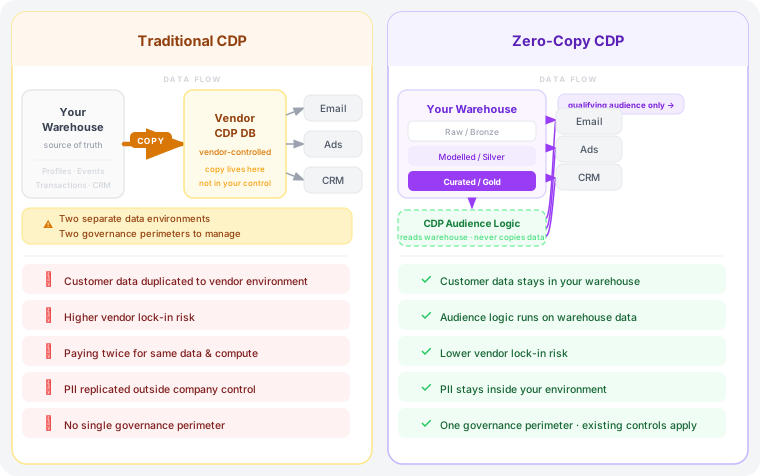
A zero-copy CDP is a customer data platform that operates directly on data already stored in a company’s cloud data warehouse or data lake, without persistent replication into a vendor-controlled database.
Customer profiles, identifiers, behavioral events, and transactional records stay where the company has chosen to govern them. The CDP reads from that store to build audiences, calculate attributes, and trigger activations. Where data movement is unavoidable — sending a qualifying audience to an ad platform, for example — only the minimum required leaves the warehouse, and only for as long as it’s needed.
What does “zero copy” actually mean here?
The term comes from systems programming, where it describes moving data through a computer without making intermediate copies in memory. In customer data architecture, the equivalent idea is: don’t duplicate the customer record into another system just to operate on it. Use the data where it already sits.
Related terms you’ll encounter:
- Zero-copy data — data used or shared between systems without being physically copied to a new location.
- Zero-copy in data cloud — a pattern in modern platforms like Snowflake or Databricks where data is accessed without materializing a separate copy in another account or system.
- Zero-copy data sharing — a warehouse capability (Snowflake data sharing, BigQuery sharing, Databricks Delta Sharing) that lets another party query your tables live, without an ingest pipeline copying the rows.
- Zero-copy clone — a warehouse feature (popularized by Snowflake) that creates a logical clone of a table for development and testing without doubling storage cost. Related in philosophy, not the same thing as a zero-copy CDP.
What a zero-copy CDP is not
It is not “the warehouse is your CDP.” A warehouse stores and analyzes data superbly; it isn’t designed to collect real-time events, resolve identity at scale, or push audiences into 80 marketing destinations. A zero-copy CDP still does that work — it just does it without demanding a parallel customer database.
It is not the same as “no copy” claims from traditional CDPs that ingest warehouse data into their own schema. That’s still a copy. It just starts in your warehouse.
It is not a synonym for real-time. Warehouses are excellent at analytical and near-real-time workloads; they are not the right substrate for sub-second event responses. Honest zero-copy architectures acknowledge this. More on that in section 10.
What Is a Composable CDP?
A composable CDP is a customer data platform assembled from best-in-class components rather than delivered as a single monolithic suite. Instead of one vendor owning ingestion, storage, identity, segmentation, and activation behind one wall, each capability can be sourced or swapped — and the warehouse typically becomes the shared storage layer for all of them.
A composable customer data architecture usually combines:
- A cloud data warehouse or lakehouse — Snowflake, Databricks, BigQuery, Redshift — as the customer data store.
- Ingestion and data collection for behavioral events from web, mobile, server-side, and SaaS sources.
- Identity resolution that stitches multiple identifiers — cookie, device, email, customer ID — into a unified profile.
- Modelling and transformation — typically dbt — to shape raw data into customer-ready tables (the bronze / silver / gold pattern).
- Audience definition and segmentation built on top of warehouse data.
- Activation and reverse ETL that pushes audiences and attributes into marketing, advertising, CRM, and engagement tools.
- Governance, observability, and consent management across the full flow.
How zero-copy and composable relate
The two terms overlap significantly in practice, but they aren’t identical.
- Zero-copy CDP describes where the data lives and whether it’s duplicated. It’s a statement about data location and ownership.
- Composable CDP describes how the system is assembled. It’s a statement about architecture and modularity.
A composable CDP that treats warehouse data as the source of truth is, by definition, doing zero-copy work for those parts of the stack. A zero-copy CDP may also be composable — many are — but a vendor can offer zero-copy capabilities inside a single product, too.
Put plainly: zero-copy is a property; composable is a pattern. Most warehouse-native customer data architectures are both.
Key takeaway: “Zero-copy CDP” is a question about where customer data sits. “Composable CDP” is a question about how the stack is assembled. Modern teams usually end up combining both answers.
Zero-Copy CDP vs. Traditional CDP
Traditional CDPs were built before cloud data warehouses were ubiquitous. They assumed the CDP would also be the customer data store: ingest events into the vendor’s cloud, run identity and attribute logic inside the vendor’s database, expose audiences through the vendor’s UI, activate from there.
That model still works for some teams. It’s fast to stand up, marketer-friendly, and well understood. But it creates a parallel system of record. Zero-copy CDP is a deliberate departure from that.
| Dimension | Traditional CDP | Zero-Copy CDP |
|---|---|---|
| Where customer data lives | Replicated into a vendor-controlled database | Stays in the company’s cloud data warehouse or data lake |
| Data ownership | Customer profiles persist on the vendor side | Customer profiles persist in infrastructure the company already owns |
| Implementation model | Ingest pipelines into the vendor’s schema | Reads existing warehouse tables; minimal new ingestion for behavioral data only |
| Governance & compliance | Two perimeters to manage; PII replicated to a third party | One perimeter; existing warehouse controls apply |
| Data model flexibility | Mapped into the vendor’s predefined schema | Reads the company’s existing customer data model |
| Cost structure | Vendor storage + vendor compute, on top of warehouse spend | Mostly warehouse compute the company already pays for, plus the CDP licence |
| Speed of activation | Fast once data is mapped in; slow to remap when the business changes | Fast when warehouse data is well-modelled; slower if the warehouse is immature |
| IT / data team involvement | Lower at setup, higher to keep mappings clean over time | Higher upfront (data modelling); lower ongoing |
| Vendor lock-in risk | Higher — customer data sits inside the vendor | Lower — the warehouse is portable, the CDP is replaceable |
What this comparison doesn’t say
Traditional CDPs aren’t wrong. For an organization without a mature warehouse, or one whose primary use case is in-session web personalization, a traditional CDP with its own storage may still be the better answer. The real question — covered in sections 10 and 12 — is whether the architecture matches the use cases.
Zero-Copy CDP vs. Composable CDP
These concepts overlap, but keeping them distinct is worth the effort.
| Aspect | Zero-Copy CDP | Composable CDP |
|---|---|---|
| Primary concern | Data location and replication | Architectural modularity |
| Defining question | Is customer data being duplicated into a vendor system? | Is the CDP a single suite or a set of interchangeable components? |
| Relationship to the warehouse | Warehouse is the system of record; CDP runs on top | Warehouse is one component among several — in practice, the central one |
| What it replaces | The vendor-side customer database | The all-in-one CDP suite |
| Common overlap | A warehouse-native composable CDP is zero-copy by design | A zero-copy CDP delivered as a single product is composable in how it integrates |
The cleanest formulation: all warehouse-native composable CDPs are zero-copy, but not all zero-copy CDPs are fully composable. Some are delivered as a single platform that happens to leave the data in the warehouse — zero-copy without being a modular stack.
Why Companies Are Moving Toward Zero-Copy CDP
The shift wasn’t caused by a single feature. It happened because the underlying conditions in the enterprise stack changed at the same time. Seven drivers stand out.
1. Cloud data warehouse adoption is now the default
Most data-mature companies have already committed large budgets and engineering effort to a cloud data warehouse. That investment is well-governed and increasingly central to how the business operates. A CDP that ignores it and rebuilds a parallel customer database is fighting the architecture the data team already owns.
2. Data ownership and vendor independence
When customer profiles, identifiers, and behavioral events sit inside a third-party CDP, the company’s most strategic asset is, in practice, held by the vendor. Zero-copy reframes this. The customer data stays in infrastructure the company owns; the CDP becomes a workload running on top of it. Swapping the activation layer no longer requires re-ingesting everything.
3. Governance, compliance, and data residency
GDPR, CCPA, sectoral regulations, and increasingly strict regional data residency requirements all care about where customer data lives, who can access it, and how it’s replicated. Every additional copy is another audit boundary. Keeping the customer record in one place — the warehouse — narrows that boundary and simplifies conversations with legal, security, and regulators.
4. Avoiding data duplication and data sprawl
Each copy of a customer record is a chance for inconsistency: a different timestamp, a different opt-out state, a different definition of “active customer.” Zero-copy attacks this directly: one record, one source of truth, one place to make corrections.
5. Cost control
The visible cost story: not paying for vendor-side storage of data that already exists in the warehouse. The less visible one: not running identity resolution and attribute calculation twice — once in the warehouse for analytics, once in the CDP for activation. Zero-copy consolidates that compute.
That said, zero-copy isn’t automatically cheaper. Warehouse compute is real, and high-frequency audience refreshes can add up quickly. More on that in section 10.
6. Better use of existing infrastructure
Data engineering teams have invested heavily in warehouse modelling, dbt projects, governance frameworks, and data catalogs. Zero-copy CDPs respect that investment. Activation logic sits alongside the modelled data instead of being re-created in a vendor schema.
7. Reducing vendor lock-in
Because the customer data stays in the warehouse, swapping a zero-copy CDP doesn’t require migrating the customer record. The new tool plugs into the same warehouse, reads the same tables, writes back to the same place.
Key takeaway: The move to zero-copy CDP is driven by cloud warehouse adoption, regulatory pressure, frustration with data duplication, and a desire to stop paying twice for the same customer record. It’s the natural consequence of the warehouse becoming the center of the stack.
How a Zero-Copy CDP Works
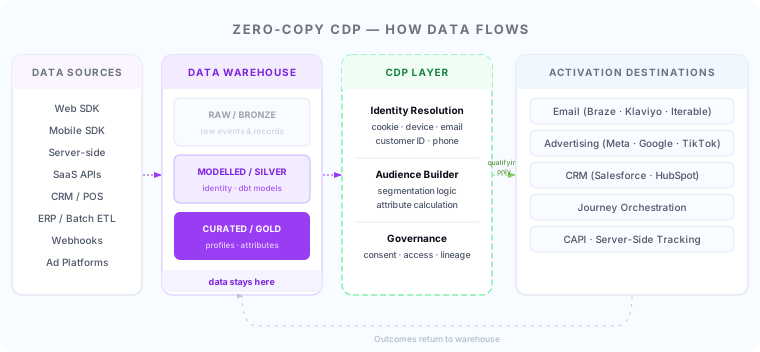
The architecture is simpler than the terminology suggests. Four moving pieces.
1. The warehouse at the center
Everything starts with the company’s cloud data warehouse or data lake — typically a tiered structure: raw/bronze data at the bottom, modelled/silver data in the middle, and curated/gold data ready for activation. Customer data lands here from many sources: behavioral events, transactions, CRM, POS, support, finance, third-party enrichment.
2. Data collection into the warehouse
Most warehouses are full of offline and batch data. Behavioral data — web and mobile events, server-side events, webhook traffic — often isn’t there by default. A zero-copy CDP that takes data collection seriously will ingest from web and mobile SDKs, server-to-server endpoints, webhooks, and the REST APIs of SaaS tools, writing that data into the warehouse in micro-batches.
3. Identity, profiles, and attributes — computed on warehouse data
Once the data is in the warehouse, identity resolution stitches identifiers into profiles, attributes are calculated, and audiences are defined. The crucial property: this is computed over warehouse data. There’s no parallel customer database on the vendor side keeping a long-lived copy.
4. Activation and reverse ETL
When marketing, CRM, or advertising tools need data, the CDP reads from the warehouse and pushes the right subset to the right destination — commonly called reverse ETL or data activation. Only profiles that match an audience condition, with the attributes that destination needs, leave the warehouse. They leave for the time it takes to deliver them.
5. Governance and observability built in
Because the customer data never leaves the warehouse for long, the warehouse’s existing controls — access policies, encryption, masking, audit logs, lineage, data catalogs — automatically apply. Observability lives where the data team is already looking.
Common Use Cases
Zero-copy doesn’t change what marketing wants to do — it changes how the data flow gets there. These are the use cases this architecture handles well.
-
Audience segmentation over warehouse data. Build segments from the same modelled tables BI already trusts — “high-value customers who churned in the last 60 days,” “users who searched a specific product line three times in a week,” “members in tier 2 who haven’t redeemed in 90 days.” Definitions stay aligned with analytics.
-
Email and CRM personalization. Push audiences and attributes into Braze, Salesforce, Klaviyo, Iterable, Customer.io, HubSpot. Personalization logic uses fields the warehouse already cleaned and governed.
-
Website personalization. Pre-compute segments in the warehouse, cache them at the edge, and serve personalized content keyed off the cached segment. (Note: pure in-session personalization under one second is not a warehouse workload — see section 10.)
-
Customer journey orchestration. Drive journeys in tools like Braze, Iterable, or Salesforce Marketing Cloud from warehouse-defined audiences, with status updates synced back so the data team can analyze outcomes in the same tables.
-
Advertising activation. Sync audiences to Meta, Google Ads, TikTok, LinkedIn, trade desks, and CAPI endpoints. Match-rate analysis happens against the warehouse, not a vendor’s black box.
-
CRM enrichment. Push attributes — predicted LTV, propensity scores, last meaningful interaction — into Salesforce or HubSpot so reps see what the warehouse already knows.
-
Near-real-time engagement. Trigger-based campaigns (cart abandonment, re-engagement, lifecycle moments) where 5- to 30-minute latency is acceptable. Behavioral events flow into the warehouse on a short cadence; the CDP picks up qualifying events and activates.
-
Lifecycle marketing. Onboarding, retention, win-back, and loyalty programs that need long-running profile state — exactly the use cases the warehouse models well.
-
Suppression lists. Do-not-contact lists, recent-purchase suppressions, support-escalation suppressions — applied from a single warehouse-controlled definition rather than maintained separately in five tools.
-
Consent-aware activation. Consent state lives next to the customer record in the warehouse, so every activation can respect it without a separate consent sync.
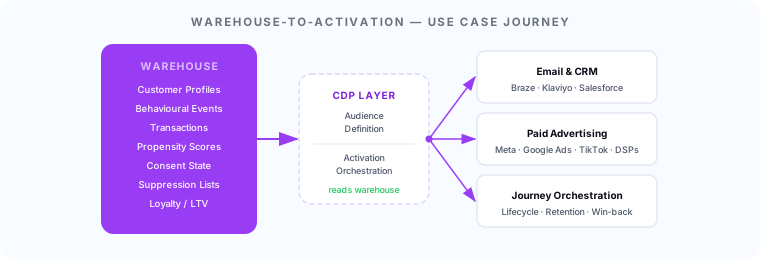
Engagement results flow back in, closing the loop.
Benefits by Stakeholder
Different roles care about different things. A good zero-copy story has an answer for each.
For marketing teams
- One definition of the audience. What the analytics dashboard calls a “premium customer” is what the campaign tool targets — both read from the same table.
- Faster activation of new attributes. An attribute calculated in the warehouse is immediately available for audience definition; no separate ingest step required.
- More flexible segmentation. Combine any warehouse column — behavioral, transactional, CRM, third-party — without waiting for a data mapping update.
For data teams
- No parallel customer database to maintain. The warehouse is the source of truth, and CDP logic respects it.
- Existing modelling pays off. dbt models, business definitions, and curated tables get reused for activation instead of being re-created in vendor schema.
- Cleaner governance and lineage. One system to monitor, one place where data lineage is tracked.
For IT and security teams
- A smaller compliance surface. PII stays inside the warehouse perimeter rather than being replicated to a third party.
- Existing controls apply. Access management, encryption, masking, residency rules, and audit logging from the warehouse automatically cover CDP workloads.
- Lower risk of data sprawl. Fewer copies means fewer ways for sensitive data to leak.
For leadership
- Stronger data sovereignty story. Customer data stays under company control, in chosen regions, under chosen contracts.
- Lower long-term vendor lock-in. Replacing the CDP doesn’t mean rebuilding the customer record from scratch.
- More leverage from prior investment. The cloud data warehouse, the dbt project, the governance framework — all of it works harder.
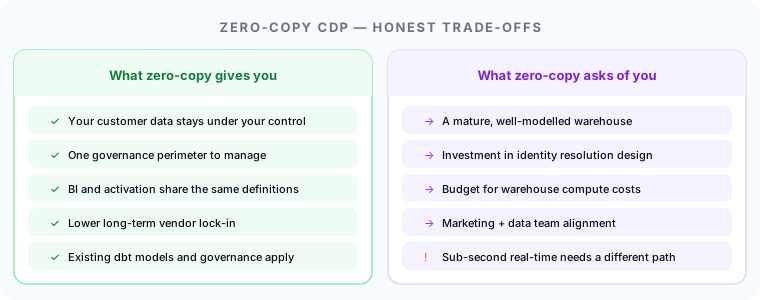
Limitations and Honest Trade-offs
A balanced guide has to be specific about where zero-copy struggles. Skipping this section is what makes vendor content read as marketing fluff.
Real-time has limits
Cloud data warehouses are not real-time systems. They excel at analytical, near-real-time, and batch workloads, and they’re increasingly fast — but sub-second event responses (in-session web personalization, immediate welcome emails, fraud-style triggers) are not their natural territory. Pure zero-copy plus pure real-time is not achievable in practice.
Vendors that claim both usually mean one of the following:
- Real-time access to data that is itself near-real-time, not real-time.
- Real-time identity stitching over a cached result of warehouse data.
- Hybrid behavior where some events are processed on a stream and only some workloads are zero-copy.
Honest architectures are explicit about which is which.
Warehouse compute cost
Every audience build, segment refresh, and attribute calculation that runs in the warehouse consumes warehouse compute. If activation frequency increases — from daily to hourly to near-real-time — that compute compounds. The cost doesn’t show up on the CDP invoice; it shows up on the warehouse bill, often surprising finance and IT. Budget for it, monitor it, and decide which use cases genuinely need high-frequency refreshes versus daily.
Warehouse maturity matters
A zero-copy CDP reads from the warehouse. If the warehouse is half-modelled, missing key attributes, or has weak identifiers, the CDP inherits those problems. Companies in the early stages of warehouse adoption may need to invest in modelling and identity work before zero-copy activation pays off.
Data quality is unavoidable
Bad data in the warehouse becomes bad audiences out of the CDP. Zero-copy doesn’t eliminate the need for data quality work — it makes it more visible, because the same definitions drive both analytics and activation.
Identity resolution still has to happen somewhere
Even when identity logic runs over warehouse data, it has to be designed. Multiple identifier types — cookie, device, email, phone, customer ID — need to be stitched, prioritized, and reconciled. Zero-copy doesn’t remove that work; it changes where it lives.
Team ownership and operating model
Zero-copy architectures often require the data team and marketing team to operate more closely than they did under a traditional CDP. The data team owns the modelled tables audiences are built from; the marketing team owns the audience and activation logic on top. Organizations not ready to operate that way will find the transition harder than the technology.
How to Evaluate a Vendor
“Are you zero-copy?” is not a useful question on its own. Different vendors use the term to mean different things. These questions cut through the marketing copy. Ask them in a demo and listen for specific answers — not slogans.
1. Where customer data actually lives
- Where do customer profiles and identifiers physically sit?
- Is any customer data persisted in the vendor’s environment? If so, for how long, and which fields?
- Is PII replicated outside the warehouse at any point?
- Can the vendor describe the exact path of a single customer record from ingestion to activation?
2. Identity resolution
- Where does identity resolution run — inside the warehouse, on vendor infrastructure, or both?
- Can the platform use an identifier the company has already built in the warehouse (bring your own identity resolution)?
- How are multiple identifiers handled? Can rules be customized?
- How is identity recalculated when new events arrive?
3. Audience definition and activation
- Can audiences be defined against any warehouse column, or only a fixed schema?
- When an audience is calculated, where does the compute run?
- What leaves the warehouse, when, and for how long?
- How is consent state honored at activation time?
4. Deployment options
- Does the vendor support zero-copy, traditional, and hybrid deployments?
- Which warehouses are supported as first-class citizens — Snowflake, Databricks, BigQuery, Redshift?
- Is there a path for organizations that aren’t fully warehouse-mature yet?
5. Governance and observability
- How does the platform respect warehouse access controls, masking, and audit logs?
- Where is lineage tracked end-to-end?
- How are data residency requirements handled?
- What happens to outgoing data sent to destinations — is it logged and auditable?
6. Marketer experience
- Can marketers self-serve audience creation without writing SQL?
- How are attributes exposed for use in audience conditions?
- What’s the workflow for a non-technical user from “I have an idea” to “campaign is live”?
7. Data team experience
- Can the data team see, version, and review what the CDP is doing in the warehouse?
- Does the platform fit alongside dbt, data catalogs, and modern orchestration tools?
- How are schemas managed when raw event data lands?
8. Pricing and total cost of ownership
- How is the licence priced — by profiles, events, destinations, seats?
- Are warehouse compute costs modelled into vendor proposals?
- What does total cost of ownership look like at one year, two years, three years — including warehouse compute?
9. Integration with the existing stack
- How many destinations are supported, and what’s the depth of integration with the company’s specific tools?
- Are reverse-ETL flows first-class?
- Can data come from SaaS sources (Klaviyo, Infobip, ad platforms, e-commerce APIs) and land in the warehouse?
10. Real-time honesty
- For each use case in scope, what is the actual end-to-end latency?
- Where caching is used to support near-real-time behavior, how stale can the cached data be?
- Which workloads are explicitly not real-time and need a different pattern?
Where Meiro Fits
Meiro approaches zero-copy CDP as an architectural choice the customer can make, not a single product mode. The product is built around two surfaces: Meiro Pipes — the customer data infrastructure layer handling event collection, transport, and integration — and Meiro Engage — the CDP layer handling profiles, audiences, journeys, and activation.
The internal framing: data warehouse’s best friend. The goal is to sit on top of cloud data warehouses — Snowflake, Databricks, BigQuery — and let the warehouse remain the central point of truth, rather than competing with it for the customer record.
What Meiro can do today in a zero-copy architecture
1. Push behavioral data into the warehouse. Pipes ingests from web and mobile SDKs, webhooks, server-to-server endpoints, and the REST APIs of SaaS tools (Klaviyo, Infobip, Magento, Firebase), and writes events into the customer’s data warehouse in 15-minute micro-batches. Default retention inside Pipes is seven days, keeping replay and error-handling possible without holding a long-lived copy.
2. Mirror profiles and attributes into the warehouse. Once identity is built and attributes are calculated in Engage, the resulting profiles can be synced into the warehouse so the data team has the unified customer record alongside the raw events.
3. Read from the warehouse as a source. Reverse ETL is a first-class source type in Pipes. The same engine that ships events into the warehouse can read from it (Snowflake, BigQuery, Postgres) and push resulting data into downstream destinations — useful when offline data (POS, ERP, batch ETL outputs) needs to be activated alongside online behavior.
4. Build audiences directly over warehouse data in Engage. Engage supports two audience modes: traditional real-time audiences calculated over data inside Engage, and data warehouse audiences that run the calculation inside the warehouse itself. In the warehouse-audience flow, nothing is computed in Engage until a marketer requests a count or sends the audience to a destination. At that point, Meiro reads the relevant warehouse data, constructs profiles, calculates attributes, filters to qualifying profiles, exports only those profiles with the attributes the destination needs, delivers them, and discards the result. The raw customer data stays in the warehouse throughout.
How Meiro handles real-time honestly
The product team’s position: real-time and pure zero-copy is not possible. Data warehouses are not real-time technology. Use cases requiring sub-second response — in-session web personalization, immediate transactional triggers — need the data inside Engage (the traditional path) or a cached layer in front of the warehouse.
Meiro’s answer is that the customer can choose per use case:
- Pure zero-copy for warehouse-driven audience activation where near-real-time latency is acceptable.
- Traditional Engage for real-time identity stitching and in-session personalization.
- Hybrid — both at once, in the same deployment — where some use cases run zero-copy and others use the in-Engage path.
Bring your own identity resolution
Some data teams have already built identity resolution inside their warehouse and produced a unique profile ID there. Meiro can use that warehouse-defined unique identifier directly, without re-stitching — fitting into customers’ existing data work rather than overriding it.
Where Meiro typically lands
Two patterns where Meiro is positioned cleanly today:
- As a behavioral-data pipeline into the warehouse. Companies whose only path to landing web and mobile data in BigQuery has been GA4 360 — and who hit the cap or the cost ceiling — can use Pipes to ingest web, mobile, server-side, and SaaS-API data into the warehouse with a broader set of integration patterns.
- As a warehouse-native activation layer. Companies whose customer record already lives in Snowflake, Databricks, or BigQuery can use Engage to build audiences directly over warehouse data and push them to marketing, advertising, CRM, and engagement destinations.
Frequently Asked Questions
What is a zero-copy CDP?
A zero-copy CDP is a customer data platform that operates on customer data where it already lives — typically a cloud data warehouse — without persistently copying that data into a vendor-controlled database. Identity, attributes, audiences, and activation logic run against the warehouse data, and only the minimum data needed to activate a campaign temporarily leaves the warehouse.
What does zero-copy data mean in practice?
The customer record doesn’t get duplicated into another system in order to be used. Different teams and tools work with the same underlying data, in the same location, under one set of governance rules.
Is a zero-copy CDP the same as a composable CDP?
They overlap but aren’t identical. Zero-copy is about where the data sits — no vendor-side replication. Composable is about how the stack is assembled — best-in-class components rather than a single suite. Most warehouse-native composable CDPs are zero-copy by design, but a zero-copy CDP can also be delivered as a single integrated product.
What is the difference between a zero-copy CDP and a traditional CDP?
A traditional CDP ingests customer data into a vendor-owned database and runs identity, attributes, and activation from there. A zero-copy CDP leaves the customer data in the company’s data warehouse and runs that logic on top of it. The practical effects are around data ownership, governance, cost structure, and vendor lock-in.
Do I need a data warehouse for a zero-copy CDP?
Yes — or a data lake/lakehouse playing the same role. The whole point of the architecture is that the warehouse is the system of record. Companies still early in warehouse adoption may need to invest in modelling and identity work first.
What is reverse ETL, and how does it relate to zero-copy CDP?
Reverse ETL is the pattern of reading data out of a data warehouse and pushing it into operational tools — ad platforms, CRMs, email tools, support tools. In a zero-copy customer data architecture, reverse ETL is how audiences and attributes get from the warehouse to the channels that activate them. Most warehouse-native CDPs include reverse ETL as a core capability.
Can a zero-copy CDP support real-time use cases?
Partially. Warehouses aren’t real-time systems, so pure zero-copy plus pure real-time isn’t achievable. Workloads that need sub-second response typically need either a cached layer in front of the warehouse or a traditional in-CDP path. Honest vendors are explicit about which workloads are real-time and which are near-real-time over warehouse data.
What are the benefits of a zero-copy CDP?
Stronger data ownership and sovereignty, simpler governance and compliance, less data duplication, alignment between BI and activation, lower long-term vendor lock-in, and better reuse of the data team’s existing investment in the warehouse.
What are the limitations or risks?
Real-time use cases need workarounds; warehouse compute cost can rise if activation frequency is aggressive; the model is only as good as the warehouse modelling underneath it; identity resolution still has to be designed; and marketing and data teams need to operate more closely than under a traditional CDP.
How do I choose a zero-copy CDP vendor?
Use the questions in the evaluation section above. Cut through “we’re zero-copy” claims by asking exactly which data is persisted on the vendor side, where identity and audience compute runs, what leaves the warehouse and for how long, what real-time latency means in practice, and how total cost of ownership — including warehouse compute — looks at one, two, and three years.
Is zero-copy CDP better for enterprise companies?
It’s especially well suited to enterprises with mature cloud data warehouses, strong governance and compliance requirements, and a data team that’s already invested heavily in modelling. Mid-market companies with mature warehouses also benefit. Companies without a warehouse, or whose CDP needs are dominated by in-session personalization, may find traditional or hybrid models a better fit.
Bringing It Together
Zero-copy CDP isn’t a label that replaces “CDP.” It’s an answer to a structural problem in the modern stack.
The cloud data warehouse has become the central customer data infrastructure. The customer data platform has to decide whether to live next to it as a parallel system of record, or to operate on top of it as an activation layer. The teams making this transition aren’t choosing between zero-copy and “good enough.” They’re choosing between paying twice — for the same record, the same identity work, the same governance — and paying once, against infrastructure they already own.
The best zero-copy architectures don’t pretend the trade-offs aren’t real. They’re explicit about real-time limits, warehouse compute cost, and the data work that has to happen for the model to pay off. They give marketers a fast, self-service audience experience. They give data teams a clean integration with the warehouse. They give security teams a simpler compliance perimeter.
If you’re evaluating a zero-copy or composable customer data architecture, Meiro is built to give you a real choice rather than a forced one:
- Use Meiro as a zero-copy CDP — keep your customer data in Snowflake, Databricks, or BigQuery, build audiences over warehouse data in Engage, and activate to marketing, advertising, CRM, and engagement tools without standing up a parallel customer database.
- Use Meiro as a traditional CDP — when real-time identity stitching and in-session personalization matter, run the workload inside Engage with data closer to activation.
- Use both in the same deployment — pick the right pattern per use case instead of compromising on one architecture for all of them.