Less data movement is a good start. But enterprise customer data architecture also needs control, trustworthy identity and the ability to act on the right context in real time.
Ask any CDP vendor whether its platform is zero-copy, and the answer is almost always yes. Ask what that actually means – what gets stored, who holds the keys, where the AI runs – and the answers quickly start to diverge.
Deloitte Digital’s The new Zero Copy paradigm, published on 23 October 2026 by David Chan, Syed Mir, Dominic Sagar, Molly Enbysk, Sebastián Toledo and Himanshu Hooda, is one of the more balanced attempts to cut through the label. It shows that zero-copy means different things depending on what persists inside the CDP and what stays in the warehouse. Its conclusion: zero-copy is less a feature than an enterprise architecture and operating model decision.
That framing is right. But it leaves a harder question open: once data stops being copied, what else decides whether the architecture is any good?
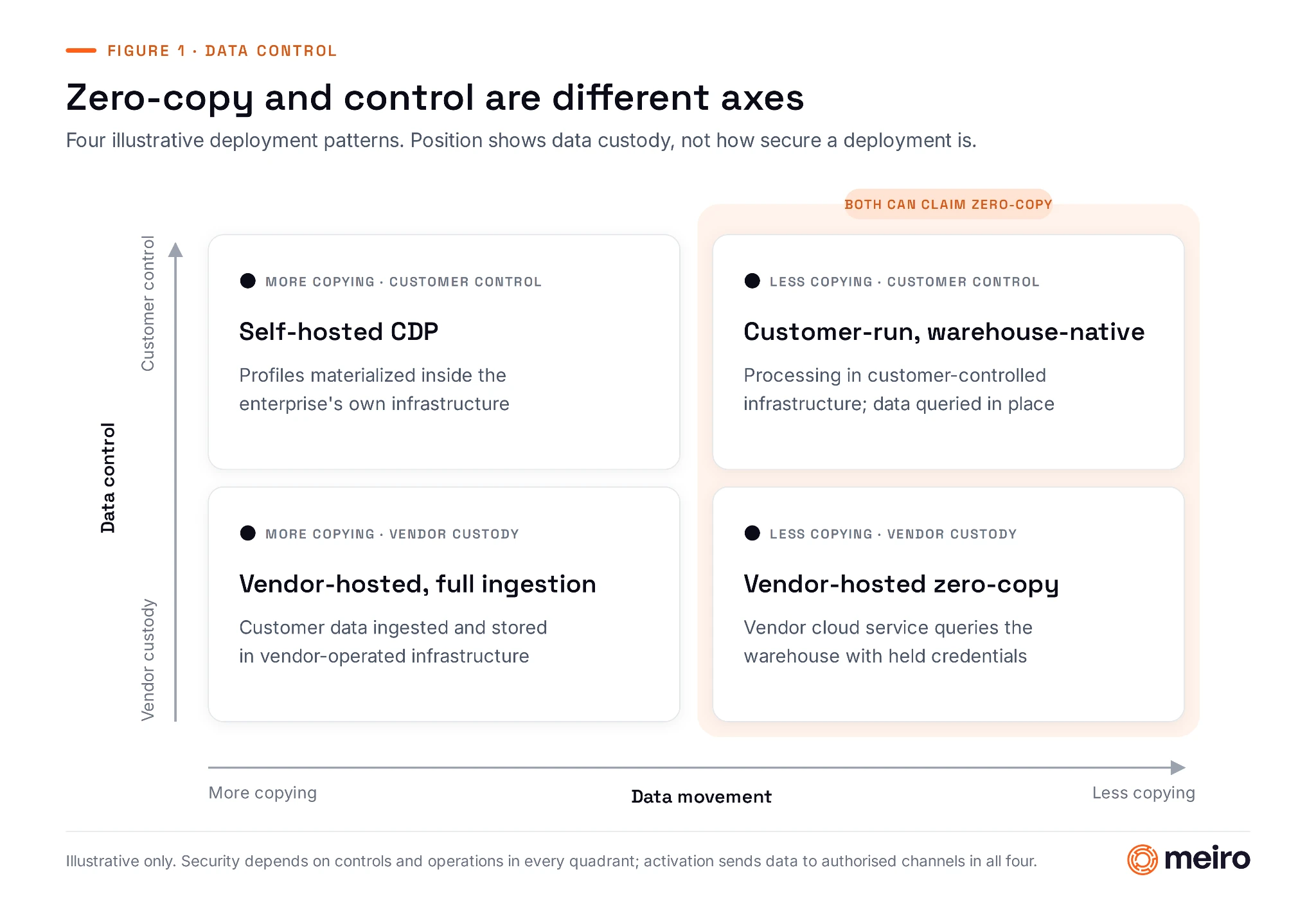
Consider two organizations. Both use a CDP that avoids replicating raw warehouse data. One runs customer processing inside its own controlled infrastructure. The other relies on a vendor-operated cloud service that holds credentials to the enterprise warehouse. Both can legitimately call themselves zero-copy. Yet their security and operational relationships could hardly be more different.
The difference comes down to three dimensions: control, identity and freshness.
What does zero-copy solve, and what does it not guarantee?
Definition. A zero-copy CDP evaluates customer data where it already lives – typically in a cloud data warehouse or lakehouse – instead of replicating raw data into its own store. As the Deloitte team stresses, this does not mean data never moves. The term does not guarantee that no data is transmitted, that no derived results are persisted, that the vendor has no access to the warehouse, or that operational overhead disappears.
The problem zero-copy solves is real. Traditional CDPs often duplicated data the enterprise already held, creating redundant storage, parallel pipelines and competing definitions of “customer.”
Deloitte identifies three data movement paradigms: standard ingestion, partial data movement and zero data movement. None wins in every case, and many organizations will use more than one.
Deloitte also shows just how slippery the label gets. Most major CDP platforms advertising zero-copy actually operate in the partial-movement paradigm: they read source data from the warehouse, but persist unified profiles, computed attributes, audiences and activation outputs in their own environment. Zero-copy rarely means zero transmission, zero persistence of derived data, zero vendor access or zero operational overhead. And activation, by definition, sends identifiers or payloads somewhere.
So the movement framework is necessary, but not sufficient. Four dimensions belong in the same evaluation:
| Dimension | The question it answers |
|---|---|
| Data movement | What is copied, persisted or transmitted, and where? |
| Data control | Who operates the infrastructure, holds the credentials and decides what leaves the boundary for activation? |
| Identity governance | Can we trust how profiles are matched, merged and corrected? |
| Decision-time freshness | What customer context is available at the moment of decision? |
Are zero-copy, private deployment and data sovereignty the same thing?
Take a bank. In architecture A, customer processing, including any materialized profiles, runs inside the bank’s own infrastructure. In architecture B, the CDP processes or persists customer data in infrastructure the vendor operates. Both may have strong controls. Both may be fully compliant. But a profile materialized inside the bank and a profile living in a vendor’s cloud are not the same thing. Both are copies; only one changes who controls the data.
That difference shows up in practical questions. Who administers the infrastructure? Which third parties hold credentials to the warehouse, and with what permissions? Where are derived profiles and activation outputs retained? And what happens if a vendor or integration is compromised?
Deloitte notes that zero-copy can make security approval more complex, not simpler, because the CDP needs direct, authenticated connections into the warehouse. It also associates zero data movement with maximum control. That holds when the query engine runs inside the enterprise’s boundary; when it runs in a vendor’s environment with standing warehouse credentials, less movement no longer means more control.
The last question is not hypothetical. In August 2025, Google Threat Intelligence Group reported a campaign in which attackers used OAuth tokens stolen from the Salesloft Drift integration to access and export data from connected Salesforce environments. No one had to copy that data into Drift first. A trusted connection was enough.
The lesson is not that SaaS is insecure or that self-hosting is immune; self-hosted systems have their own supply chains. It is that third-party access and trust relationships are part of the security architecture, even when source data never moves.
Private deployment, on premises and zero egress. These terms describe where a CDP runs and what leaves it, which zero-copy alone does not. In a private or self-hosted deployment, the CDP runs inside the enterprise’s own cloud account, private cloud or on-premises data center, so the enterprise administers the infrastructure, the credentials and any retained profiles. “Zero egress” is often used to promise that no customer data leaves that environment. Taken literally, that rarely holds: activating a campaign sends identifiers or payloads to email, advertising and messaging channels. The precise claim is narrower: no mandatory transfer of customer data into vendor-operated infrastructure, with only configured activation deliveries leaving the boundary. For banks, insurers, telecom operators, healthcare providers and public-sector bodies with data residency obligations, that distinction often matters more than the number of copies.
Data movement and data control are two different axes. Enterprises should evaluate both.
Can customer identities be trusted simply because they are resolved in the warehouse?
Deloitte rightly notes that warehouse-native architectures often shift data preparation and identity work onto enterprise data teams. That work is harder than writing a SQL join.
Real customer data looks like this:
- A family tablet shared by three people
- A placeholder address like info@example.com attached to hundreds of orders
- One bad identifier quietly merging two unrelated customers
A naive identity graph turns that last case into contaminated marketing, personalization and reporting, and every downstream system inherits the mistake.
Robust identity resolution needs explicit rules. That means identifier priorities and confidence levels, caps that stop one identifier from pulling in thousands of profiles, protection against shared-device and placeholder collisions, quarantine for ambiguous cases, the ability to reverse a wrong merge, and a clear trace of why two records were connected.
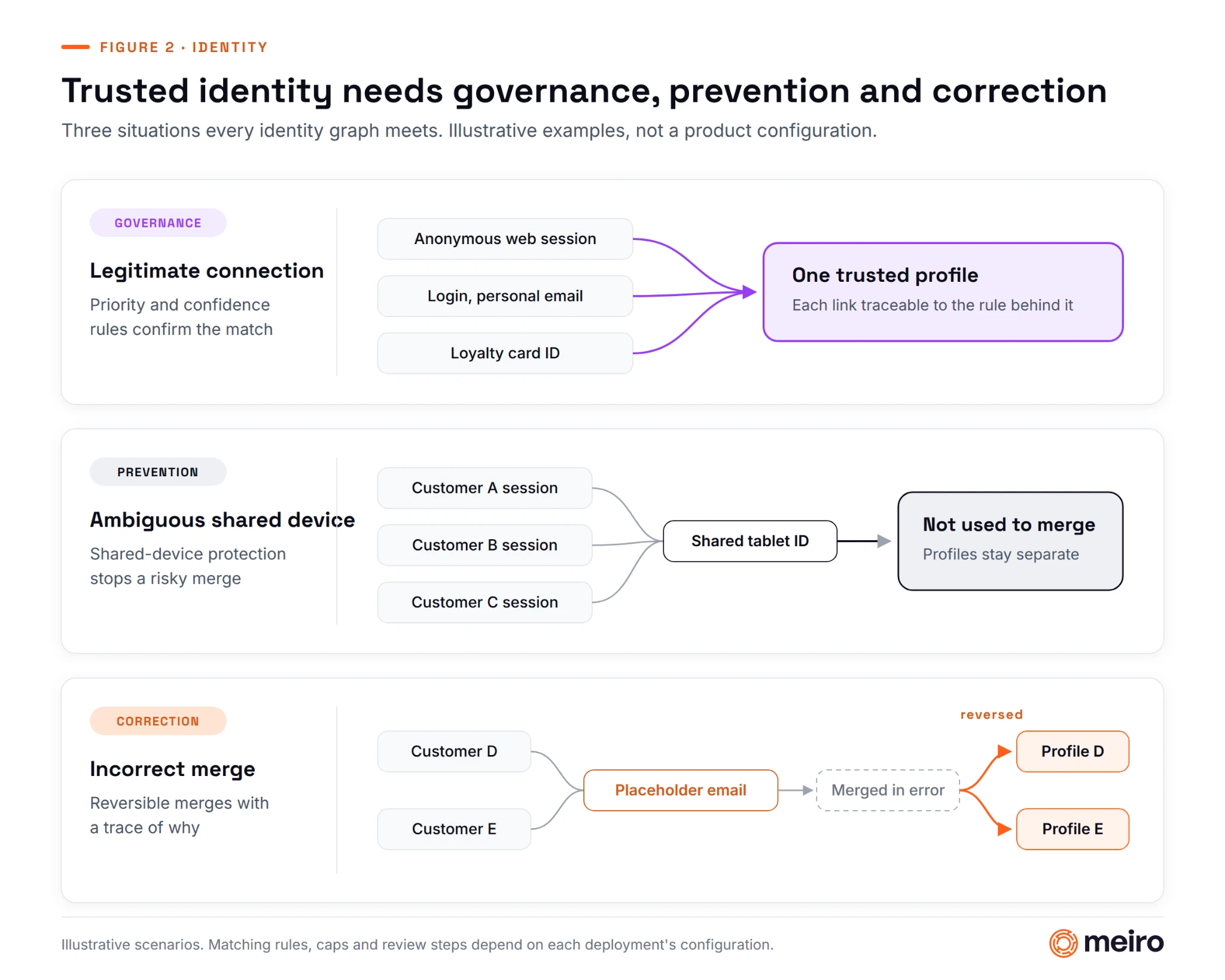
None of this means identity resolution cannot happen in the warehouse. It can. But identity is an operational capability with rules, safeguards and recovery procedures, and moving compute into the warehouse does not make that complexity disappear. The question is not only where profiles live, but whether they can be trusted.
How can a daily-trained model respond to a customer’s latest behavior?
Picture a customer who browses running shoes, changes their mind, moves on to camping gear seconds later, then returns to the homepage. The recommendation model behind that homepage was trained overnight on months of history. That is not a problem in itself. The problem starts if the recommendation ignores that change of intent.
It helps to separate three clocks that often get blurred together:
- Model freshness: when the underlying model was last trained.
- Profile freshness: when the customer’s latest events were processed and made available.
- Decision freshness: what context was actually considered when the recommendation or next action was generated.
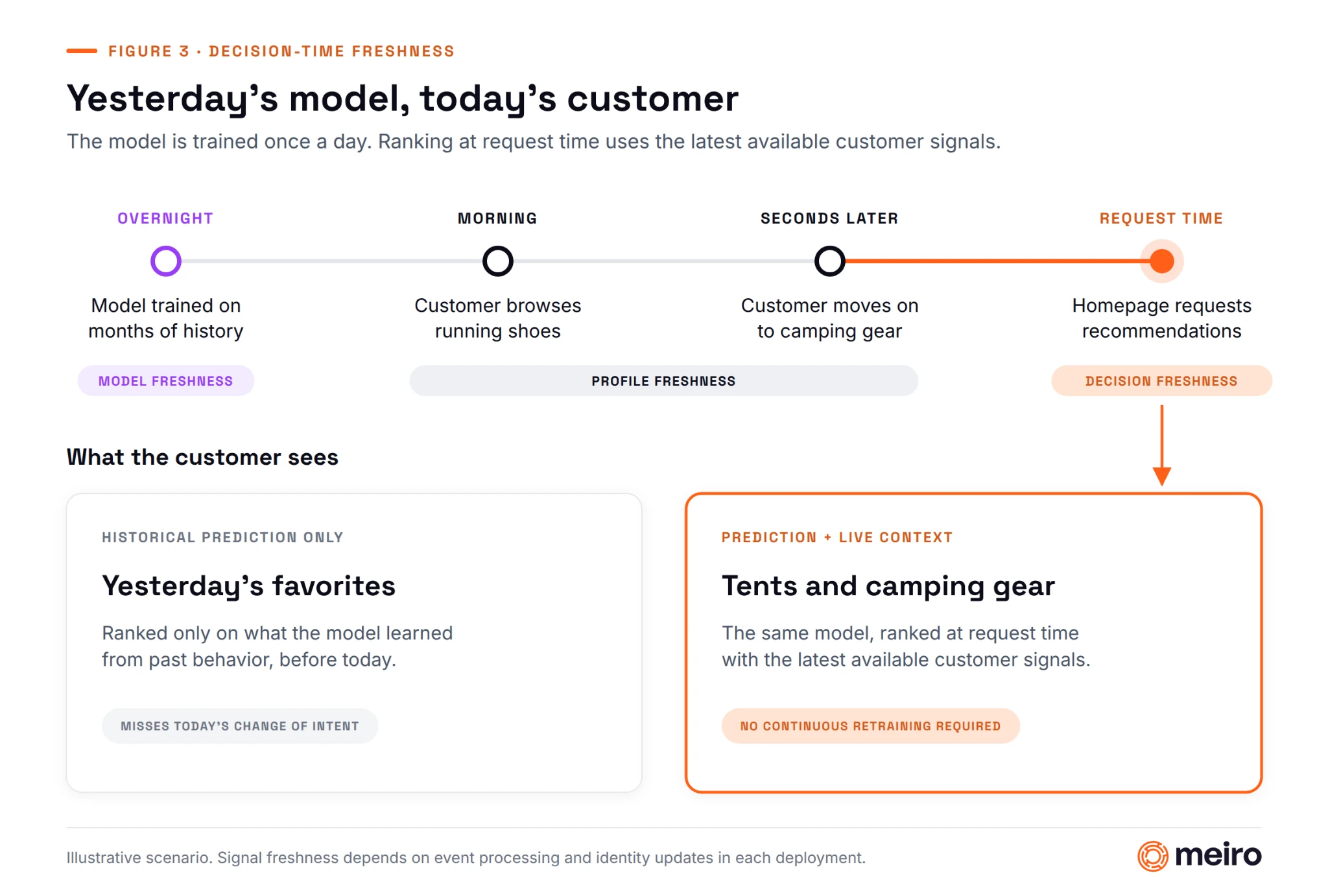
A daily-trained model can still produce relevant results if recent behavior shapes the ranking at request time. Continuous retraining is not required; the latest signals simply have to reach the decision.
The same logic applies to customer journeys: if a delayed identity update hides a completed purchase, the system may still send an abandoned-cart reminder. The customer does not care whether the cause was a warehouse query, a cache or a CDP.
Warehouse execution is excellent for analytics, historical attributes and scheduled segmentation. Low-latency interactions put pressure on query speed, processing delays, serving infrastructure and cost, and some justify dedicated stateful processing or materialization. Deloitte reaches the same conclusion: active profiles used for real-time personalization may justify full ingestion, while other data stays in the warehouse and is queried on demand.
Fresh data only matters if it reaches the decision when it matters.
When should work stay in the warehouse, and when is materialization justified?
The choice is not between a traditional packaged CDP and a purely warehouse-native or composable stack. A good architecture lets you make different decisions for different workloads.
| Workload | Architectural priority |
|---|---|
| Historical segmentation | Use existing warehouse data and compute |
| Identity resolution | Govern matching, conflicts and reversibility |
| High-frequency personalization | Reliable access to the latest usable context |
| Marketing activation | Controlled delivery into channels |
| Regulated customer data | Private or on-premises deployment, permissions and auditability |
Whether customer data lives in Snowflake, Google BigQuery, Databricks, Microsoft Fabric or PostgreSQL, the useful question is not simply whether a CDP copies it. It is which work can stay in the warehouse, how identity is governed, and what context will be available when a customer decision has to be made. Latency, query cost, identity workflow and data custody should be validated for each deployment rather than assumed as universal guarantees.
A related shift, raised by practitioner Rajan Kumar in the LinkedIn discussion of the article, is the rise of semantic layers that tell AI agents what “customer,” “active” or “churn risk” mean across systems. These raise the stakes further: if identities are wrong or context is stale, a semantic layer simply helps an agent be confidently wrong, faster.
Architectural flexibility is a strength when it follows real requirements rather than a vendor’s preferred label.
How does Meiro approach these trade-offs?
Meiro Pipes and Meiro Engage run on a shared backend, connecting customer data infrastructure to the systems that act on it. Depending on the deployment, Meiro can query customer data where it already sits in the warehouse or run within customer-controlled infrastructure as a self-hosted, private deployment. When self-hosted, there is no mandatory transfer of customer data into Meiro-operated infrastructure; only configured activation deliveries leave the deployment boundary.
The same principle now extends to AI. Zero-copy determines where customer data is stored, not where an AI model reasons over it, which is why Meiro made its Local AI CDP generally available in October 2026: the model runs inside the same deployment as the customer data, on premises or in a private cloud, so personalization and next-best-action do not require sending customer context to an external AI provider.
Three examples of where the arguments above show up in the product:
- Identity: identifier caps, priorities and overflow protection, plus the ability to reverse an incorrect merge.
- Decisioning: recommendations combine trained models with the latest available customer signals at request time.
- Operational correctness: a journey can wait for a profile to be up to date after an identity update before it takes the next decision.
What should enterprises ask instead?
Zero-copy is an architecture and operating model decision, not a feature checkbox. So instead of asking only whether a CDP is zero-copy, ask:
- Who controls the data, and where does the infrastructure that processes it run: vendor cloud, private cloud or on premises?
- Can we trust how customer identities and profiles are created, merged and corrected?
- Can we act on the right customer context at the moment a decision matters?
Avoid moving data unnecessarily. Avoid surrendering control without understanding the consequences. And never compromise the customer experience in pursuit of architectural purity.
Organizations working through these trade-offs can explore how Meiro approaches customer data architecture or arrange an architecture discussion with the Meiro team.